Macedonia ... Center of the Universe - Mother of the World - The cradle of European Civilization...
Friday, October 11, 2013
Similarities between ancient Macedonian language and today's' Macedonian language
Apell(es). The root of this name contains the noun "apel" (a call) which we have in the present day Macedonian language.
Atarhi(as). The root of this name contains the noun "atar". This is a Macedonian archaism for the word "love". Names that contain the word "love" exist in a majority of lexicons.
Bere(s). The root of this name contains the verb "bere" (to pick up) that exists today in the Macedonian language and in other "Slavic" languages. Also in the present day Macedonian onomasticon there are names derived from verbs. The name "Bere" is present In todays' Macedonian onomasticon.
Crater(us)32). The root of this name contains the word "krater" (crater) which exsists in the present day Macedonian and other "Slavic" languages. In todays' Macedonian onomasticon is present the name "Krate".
Caran(us)33). This name might be connected to the present day Macedonian noun "kruna" (a crown). The name "Karanche" is present In todays' Macedonian onomasticon.
Dada. The noun "dada" in the present day Macedonian language means "older sister". The name "Dada" is present In todays' Macedonian onomasticon.
Daron. This is a name for the ancient Macedonian god of healing. Its etymology is known, and it means "he that gives health." This means that the name of this god contains the Macedonian noun "dar" (a gift). The names Darun, Dare, Dara and others are present in todays' Macedonian onomasticon.
Del(us). The verb "dela" (to work) exists in the so called "Old Slavic language", as well as in several present day "Slavic languages". The name "Dele" is present In todays' Macedonian onomasticon.
Dimno(s). The adjective "dimno" exists in the present day Macedonian language and still means "steamy The names Dimna, Dimon, Dimnak and others are present in todays' Macedonian onomasticon.
Diplai(os)34). A name of an upper Macedonian (Payonian) ruler. In his name is the noun "dipla" that in dialectal form in the present day Macedonian language means a bouquet of flowers. The noun "dipla" is also used as a designation for a type of old Macedonian instrument.
Dita. The noun exists in Slavic languages as "dite" or "dete", which means "a child". In 19th century Macedonian onomasticon was recordered the same name "Dita".
Dita(s). This is an obvious form of the preceding name Dita, but it has been Hellenized with the suffix "s".
Dud(es). The noun "dud" (a type of wood) exists in several "Slavic" languages. The names Dude and Duda are present in todays' Macedonian onomasticon.
Glaukia(s)35). Could this name be derived from the noun "glava" (a head)? In 19th century Macedonia one finds the male name Glavko.36)
Gauan(us). This is an old originally ancient Macedonian name, first mentioned by Herodotus. It has obvious similarities to the noun "gaval", that represents an archaism for the "kaval" (a short Macedonian wind instrument). In 15th century Macedonia one finds the male names: Gavale and Gavala.
Kopria. This name has possible connections to the noun "kopra" (a dill). It is a well-known practice to derive personal names from those of the plant world. In 16th century Macedonia one finds the female name Kopra.
Lasten. This name may be connected to the noun "lastovica" (in Serbian: "lasta"), which means "a swallow". The name Laste is present in today's Macedonian onomasticon.
Lyka. This female Macedonian name, which exists in the present day language, is possibly derived from the noun "lika" (a face, pretty face). The name Lika is present in today's Macedonian onomasticon.
Milo. This name was mentioned by Plutarch as a name of a Macedonian military leader in the Macedonian-Roman conflicts. This name exists to the present day in the Macedonian onomasticon. It has an obvious identification with the present day Macedonian adjective "milo" (dear), from which a number of names are (Milosh, Milko, Milka).
Mesti(us). The root of this name contains the noun (archaism) "mesti" (small childrens' shoes made from wool). In later Macedonian onomasticon there were also names derived from pieces of clothes.
Mamina. This name fully corresponds to the present day Macedonian adjective "mamina" (the one who belongs to her mother). In 18th and 19th century Macedonia one finds the female name Maminka.
Mama. This is identical to the present day Macedonian noun "mama", which in any case, exists in other languages. In 15th century Macedonia one finds the female name Mamica (deminutive for Mama).
Mama(s). It is obvious that this is a Hellenized variant on the previous name.
Manta. The noun "mantija", that exists in the present day Macedonian language represents a type of long garment. In 19th century Macedonia one finds the same female name Manta.
Mantyes. This is probably a variant of the previous name. The spoken form of this word (without the suffix "s") is still closer to the noun "mantija".
Med(es). The root of this name contains the noun "med" (honey), which exists in todays' Macedonian language as well in most other "Slavic" languages. The name Mede is present in todays' Macedonian onomasticon.
Myrcin(us). Name of a king of an ancient Macedonian tribe Edoni, mentioned by Herodotus. If we remove the Greek "us", we get the name Myrcin (Mirkin). To the present day in the Macedonian language there is the female name "Mirka" (derived from the noun "mir", which means peace), while "Mirkin" is an adjective which means "The one who belongs to Mirka". Among the Macedonians, right up to the 20th century, men frequently received names derived from their mother's name (Kanin son of Kana; Mirkin son of Mirka and etc.). Could that be the case with this name? The names Mirkan, Mirin and so on are present in todays' Macedonian onomasticon.
Mucati. The verb "mucati" exists in a number of the "Slavic" languages. In the Macedonian language the verb "mucna" means "to speak". Maybe this name can be connected to the noun "mucka" (snout). If we read "c" as "k", then maybe the root of this name can be connected to the noun "mukach" (which means a cry baby). The names Mucan Muce, Mucko, Mukan, Muko are present in todays' Macedonian onomasticon.
Nana. The noun "nana" in the Macedonian language today is used to signify an older female relative. In dialectal form "nana" takes the form of the verb, to sleep. The name Nana is present in todays' Macedonian onomasticon.
Pita. The noun "pita" (a type of food), can be found in a number of "Slavic" languages. In todays' Macedonian onomasticon is present the name Pito. There are other Macedonian names derived from the food: Piroshka, Pituluca and others.
Pittak(os). Could this be a variant of the previous name? The noun "pitach" exists in the present day Macedonian language, with the meaning, "one who begs". The names Pito and Pitako are present in todays' Macedonian onomasticon.
Plator. The noun "plat" exists in the present day Macedonian language as a type of high quality cloth. The suffix "or" is encountered in other male personal names, which means that it is independent of the root "plat". The name Platin is present in todays' Macedonian onomasticon.
Pyri(as).The root of this name could be connected to the noun "pir" (merriment). The name Piri is present in todays' Macedonian onomasticon.
Pyrh(os). This is probably a variant of the previous name.
Perustae. The noun "perustija" in the present day Macedonian language means an iron spit for cooking meat over a fire, an item that had great significance in the preparation of food in the past. The name Peruska is present in todays' Macedonian onomasticon.
Rumi37). A female name that could possibly be connected to the adjective "rumena" (ripe red). In todays' Macedonian onomasticon there is name "Rumi", which is short form of the name "Rumena" (ripe red).
Sita. A name that is identical to the present day Macedonian adjective "sita" (eating to satisfaction). The male name Sitko is present in todays' Macedonian onomasticon.
Sopol(is).This ancient Macedonian name is mentioned by the Greek historian Arrian as the name of a Macedonian officer in the army of Alexander the Great. It obviously contains the root "sopol" (a strong spring) from the so called "Old Slavic language". The name Sopol is present in todays' Macedonian onomasticon.
Stasanor. This name contains the present day Macedonian adjective "stasan" (ripe). We've said that the suffix "or" can be found in other male names, which means that it is outside of the root "stasan". The names Stasin, Stase and Staso are present in todays' Macedonian onomasticon.
Silen(us). Name of a forest demon in Brygian mythology. The root of this name contains the present day Macedonian adjective "silen" (that which has spiritual or physical strength). In middle age Macedonia one finds the names: Silan, Silano and Silane.
Stamen(os)38). The root of this name contains the present day Macedonian adjective "stamen" (reliable, firm). The name Stamen is present in todays' Macedonian onomasticon.
Sever(os). The root of this word contains the noun "sever" (north), which exists in in a number of present day "Slavic" languages. The name Sever is present in todays' Macedonian onomasticon.
Sipa. In the Macedonian language there exists the noun "sipa" (a type of fish), which lives in Macedonian lake waters. It is a well known practice to derive personal names from the names of animals. The name Sipe is present in todays' Macedonian onomasticon.
Sipa(s). This is obviously a Hellenized variant of the previous name.
Scritia39). The adjective "skrita" (secret) is apparent in this name that exists in "Slavic" languages.
Tata, Tato, Tataia. These are obvious variations of a name derived from the noun "tato" i "tata", which means "a father" and can be found in several "Slavic" languages. The name "Tataia" probably is a variant on these two names. In middle age Macedonia one find the names: Tato, Tate, Tatko, Tatka, Tatin.
Temen(os). The root of this name contains the present day Macedonian adjective "temen" (dark).
Traizina. The root of this word may contain the present day Macedonian adjective "trazena" (expected, sought).
Tip(as). The root of this name contains the noun "tip" (type), which is a word found in several Slavic languages. The names Tipa and Tipe are present in todays' Macedonian onomasticon.
Vitel(is). The root of this name contains the noun "vitel", which is found in the present day Macedonian and still means (whirlpool). The name Vitol is present in todays' Macedonian onomasticon.
Zaika. This is one of the most interesting ancient Macedonian female names. It may represent a female form of the present day Macedonian "zajak" (rabbit). In any case, there are numerous examples of names taken from names of animals. The names Zaia (Zaja) and Zaiko (Zajko) are present in todays' Macedonian onomasticon.
Zaimina. The present day Macedonian language contains the adjective "zemjina" (in dialectal form "zemina") which means "the one who belongs to Earth". There is also the adjective "zimna" (the one who belongs to the winter"). The name Zemko is present in todays' Macedonian onomasticon.
Saint Jovan Bigorski Monastery
The Monastery of Saint Jovan Bigorski is a Macedonian Orthodox monastery located in the western part of Macedonia, near the road connecting the towns of Debar and Gostivar.
The monastery church is dedicated to St. John the Baptist. According to the monastery's 1833 chronicle, it was built in 1020 by Ivan I Debranin. The Ottomans destroyed the monastery in the 16th century. The monastery was restored in 1743 by the monk Ilarion, who also built several monk cells. Later, in the period from 1812 to 1825 the monastery was expanded by archimandrite Arsenius. Among the donors there is also a mention of a monk Iov, recognized by some researchers as the future educator Yoakim Karchovski. One of the most valuable treasures of the monastery is the iconostasis created by Petre Filipovski Garkata from the nearby village of Gari. This iconostasis is considered as the most beautiful and most valuable wood-carved iconostasis. Another valuable monastery treasure is an icon dating from 1020 with supposedly miraculous healing power.
Most of the old monastery complex was burnt down in 2009, while the new sections of the complex and church were saved. Reconstruction of the old palaces begun in May 2010 with the aim to reconstruct it as authentic as possible.
Wednesday, September 25, 2013
THE ANCIENT TOWN OF HERACLEA LYNKESTIS
Today on the ground of Heraclea the remains of more sacred objects are found, decorated with floor mosaics made in opus sectile and opus tessalatum, dating from the 5th and 6th centuries. It is a small basilica (A), civil basilica (B), the great basilica (C) located about 250 meters from the downtown area of Heraclea, despite that, here are found early Christian and medieval tombs, then portico courtroom from the Roman period (2nd century VN) bath from the Roman period (2nd century VN), theater from the Roman period (2nd century VN), episcopal residence from early Christian times (4 to 6th century), city tap water from the time of Justinian (562). In its place today are held and various cultural events. It is open for visits every day from 8 to 19 pm with advance notice. |
Tuesday, September 24, 2013
Did you know that Pesna Cave has the biggest entry in the Balkan?
Enigma about the entry – According to speleologists Pesna has the biggest entry in the Balkan - 30 meters height. According to the "natural heritage", the entry has significant dimensions: 16.8 x52, 4 m.
A few hundred meters from the cave runs Treska River, ideal for fishing and picnics. Also there is a fishpond in motel Pesna.
![]() |
| Pesna cave |
The cave is close to the village Makedonski Brod. If you take the road from Prilep to Kicevo, take the turnoff to the village Modriste, just before Makedonski Brod.
It has been used as a shelter in times of war and crisis. It has easy access and it is open to visitors.
The legend has it that this fortress used to be the home of Pesna, the sister of King Marko (1335- 1395).
Sunday, September 22, 2013
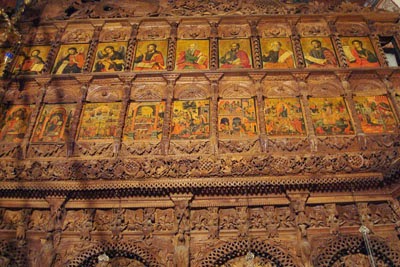
Did you know about Iconostas of the Monastery of St. John the Baptist?
Monastery of St. John the Baptist is known for its iconostasis. He was drafted by Petre Filipov – Garkata from village of Gari. It is built by craftsman`s hands of Petre Filipov - Garkata village of Gari. Along with his brother Mark Philip, Makrarij Frchkovski of Galichnik and Abraham Dichov with his sons Vasil and Filip from Filipovci Osoj in the period from 1829 to 1835, managing to create beautiful artistic wooden procedure.
The iconostasis is divided into six horizontal bands. The first is basically composed of rectangular fields that have ornaments of flora and fauna. The second zone, which moved throne icons, ends with a figure of an eagle with spread wings. The third area is divided into three smaller horizontal separations that are symmetrically distributed angels, grapes and vines, etc. Above them are two rows of icons - with images of apostles. In the center is the large cross on which Crucifixion of Christ. On both sides of the cross are figures of a dragon whose mouth is raised icons of John the Baptist and the Holy Mary.
Saturday, September 21, 2013
Did you know about Platanus Orientalis in Ohrid?
The oldest tree in Macedonia is the Platanus Orientalis in Ohrid. Whether a coincidence or not, the tree is growing since St. Clement of Ohrid period, in the 9th century.
Oriental plane, is a large, deciduous tree of the Platanaceae family, growing to 30 m and known for its longevity and spreading crown.The name derives from its historical distribution eastward from the Balkans, where it was recognized in ancient Greek history and literature. Following Greek usage it is called platane or related names in continental Europe. It was equally famous to the Iranian-speaking world and from Turkey to India is called chinar.
Wednesday, September 18, 2013
Why is Greece Stealing the Macedonian History?
![]() |
| Macedonia |
Historian and Professor Eugene Borza who is credited as "Macedonian specialist" by the American Philological Association, and who have done extensive studies regarding the ethnicity of the ancient Macedonians, had also presented in-depth analysis on the modern Greek position which claims that the ancient Macedonians "were Greek". In his In the Shadow of Olympus (p.91-92) Borza writes:
"Thus, long before there was a sufficient ancient evidence to argue about the ethnic identity--as revealed by language--of the ancient Macedonians, there emerged a "Greek" position claiming that the Macedonian language was Greek, and that thus the inhabitants were Greek."
The modern Greeks have therefore, developed a position that the Macedonians were Greek, long before there was sufficient ancient evidence to argue about their ethnicity. Yet although modern historiography had long abandoned this prematurely established "Greek" position, modern Greeks are still its most zealous defendersdespite the overwhelming evidence available today, which overwhelmingly shows that the Macedonians were not Greeks but a distinct nation. Borza continues:
"For example, recent work describes the funerary stelae found in the tumulus covering the royal tombs at Vergina. These stelae date from the fourth and early third centuries, and the preponderance of names are Greek… The excavator of Vergina, Manolis Andronikos, in a useful summary of the epigraphic evidence, writes: "In the most unambivalent way this evidence confirms the opinion of those historians who maintain that the Macedonians were a Greek tribe, like all the others who lived on Greek territory, and shows that the theory that they were of Illyrian or Thracian descent and were hellenized by Philip and Alexander rests on no objective criteria." Manolis Andronikos Vergina:The Royal Tombs, 83-85."
Here is Borza’s answer to the Greek archeologist Manolis Andronikos:
"This argument is true enough only as far as it goes. It neglects that the hellenization of the Macedonians might have occurred earlier then the age of Philip and Alexander, and can not therefore serve as a means of proving the Macedonians were a Greek tribe."
Indeed, not only Andronakis was obviously wrong to conclude that the Macedonians were Greek, but also notice how the Greek archeologist does not point that the Macedonians might have been a separate nation. Instead he prefers to call it if not Greek, either Illyrian or Thracian, two ancient nations that can not be associated with the Balkans politics surrounding Greece, resulted from the 1913 partition of Macedonia (see below). Also notice how Andronikos used the term "like all the others who lived on Greek territory". It’s like he wants to convince the reader that Macedonia has always been a "Greek territory", which is exactly what he uses as a base for his inaccurate conclusion.
Another Greek writer, Michael Sakellariou, in his Macedonia 4000 years of Greek History, 44-63 (quite questionable of accuracy title to begin with), "proves" that the "Macedonians were Greek" although he purposely avoided all evidence that does not suit such conclusion. Borza has a line for him as well:
"It is indicative of the strength of Badian’s case that his critics have succeeded only in nit-picking: e.g., Sakellariou, Macedonia, 534-35 nn. 52.53" (Borza, In the Shadow of Olympus p.96.)
Borza is talking about Ernst Badian from Harvard University who in his extensive research Greeks and Macedonians presented all evidence and soundly concluded that the Macedonians were distinct nation from the Greeks, which neither considered themselves to be Greeks nor were considered by the Greeks to be Greek. Thatis precisely what the Greek writer Sakellariou had completely and purposely avoided, and lacking any base for a well-balanced criticism, choused instead to nit-pick Badian's argument.
We can see a trend among the Greek scholars (Andronicos, Martis, Daskalakis, Kallaris, and Sakellariou) who desperately want to show the world that the Macedonians "were Greeks", though unsuccessfully. Martis'Falsification of Macedonian History was handed out to the foreign journalists in Greece and translated into many languages. Sakellariou’s Macedonia 4000 years of Greek History was even donated for free to the libraries throughout the United States. This exposes a well-developed propaganda strategy, to influence all those unaware that the "Macedonians were Greek." Yet the Greeks are showing the world that the "Macedonians were Greek" by avoiding all ancient and modern evidence that does not suit their purpose, and in that process they try to pass books so full of historical errors and distortions:
"The fullest statement of the "Greek" position, and also the most detailed study of the Macedonian language, is by Kallaris, Les anciens Macidoniens, esp. 2: 488-531, in which alleged Greek elements in the Macedonian language are examined exhaustively. A more chauvinistic (and less persuasive) point of view can be found in Daskalakis, Hellenism, esp. pts. 2. and 3. The most blatant account is that of Martis (The Falsification of Macedonian History). This book, written by a former Minister for Northern Greece, is an polemical anti-Yugoslav tract so full of historical errors and distortions that the prize awarded it by the Academy of Athens serves only to reduce confidence in the scientific judgment of that venerable society of scholars. The most sensible and scholarly Greek position is that laid out by Sakellariou, inMacedonia, 44-63. Lest it seem, however, that the "Greek" position is held only by modem Greeks" - (Borza, In the Shadow of Olympus p.91)
It is ironical that the book of the former Greek politician Nicolas Martis is named The Falsification of Macedonian History, when in fact he is the one who is falsifying the history of Macedonia with his historical errors and distortions. It is worrisome that the students of the countries who have nothing to do with the modern Greek politics, must be exposed to the Greek historical fabrications against one of the most dynamic powers of the ancient times - the Macedonians. But why is Greece doing this, what is behind it, why do they steal the history of the ancient Macedonians, and attempt to appropriate it as theirs?
The answer lays in the year of 1913 when Macedonia was partitioned after the Balkan wars and Greece swallowed the biggest part - 51%. There was nothing in Macedonia then that connected that land with Greece, apart from the small 10% Greek minority scattered in southern Macedonia among the overwhelming majority of Macedonians who lived throughout the country (for complete statistical evidence see the "Macedonian-Greek Conflict"). Since in 1913 it acquired foreign territory populated by non-Greeks, Greece had to provide a link that would justify its claim on that half of Macedonia. That is exactly why the Greeks claim that the ancient Macedonians "were Greek", so that if in ancient times there was a Greek tribe (Macedonians) living in Macedonia, then that land therefore is Greek (just like Andronikos points above). What is not disputable however, is that since 1913 till today, the modern Greek state continues to oppress the ethnic Macedonians who now find themselves living in Greece (see Human Rights Watch, Amnesty International evidenced in the "Macedonians in Greece"). The other northern part of Macedonia, today’s Republic of Macedonia, broke out of Yugoslavia and became independent in 1991. That brought addition fuel to the Greek nationalists who are afraid now that one part of the ethnic Macedonian nation is independent, the partition of 1913 can be seen as illegal, which could lead to eventual loss of their Greek Macedonian part and subsequent reunification of one Macedonia. That is exactly why they claim that there is no modern Macedonian nation, not in Greece not anywhere, and continue to deny the basic human rights of their Macedonian minority through politics filled with paranoia, politics which without the revision of the ancient history could not breathe.
Wednesday, September 5, 2012
Golden mask - Macedonia
For those lucky visitors to Ohrid who get the opportunity to spend time with one of Macedonia’s pre-eminent archaeologists, Pasko Kuzman, a world of ancient relics and remarkable stories awaits.
Ensconced in his element, the wonderful repository of antiquities he carefully oversees at the city’s museum, the archaeologist is glad to spread his infectious enthusiasm for the great potential of Macedonian archaeology- according to him, a resource still largely untapped.
Some of Mr. Kuzman’s notable achievements include the discovery of the priceless Ancient Macedonian golden mask of Ohrid, similar to four previously found at the necropolis of Trebenista, the faithful reconstruction of the Byzantine church of Plaosnik, and the ongoing excavation of a 3,000 year-old settlement now submerged deep under water near the village of Gradiste, tucked halfway down Ohrid’s southeastern shore.
In July, more excavations in the central fortress of the medieval Tsar Samuel unearthed remains of what is believed to be the first fortress of King Philip II of Macedon, dating back to the fourth century B.C.
Kuzman also began the excavation works in Vevchani, where the ruins of a mysterious church were discovered last fall. With the warm spring weather now returning to Macedonia, excavations will resume and hopefully the church will divulge its secrets soon enough (though he recently told us that they have not yet resumed).
The museum in Ohrid is housed in a grand and stately old building. The cozy laboratory where Kuzman and his assistants work is located several floors up a narrow stairway. On a long worktable illuminated by white lights, penciled index cards and drawings of artifacts overlay ancient finds in the process of documentation. Neatly assembled along the shelf behind are rows of ancient Macedonian battle helmets, swords, jewelry and pots.
As Kuzman merrily works away on cataloguing the enormous backlog of little treasures on the table, he points out the presence of the Star of Vergina, the symbol of the ancient House of Macedon, found on rounded drinking vessels among other objects. He points to this fact with satisfaction: “it indicates that this was an Ancient Macedonian, and not some other civilization that lived in Ohrid’s ancestor,Lychnidos.” The decoration is shaded in red and yellow pencil on a worn old booklet suited for the purpose.
The shelves are lined with spears and arrowheads, daggers and necklaces and curving vessels. There are rusted, narrow-fitting helmets, and round-topped ones with almost a sort of metal visor brimming out. But the most beautiful among them is a shone bronze helmet, adorned with wreath and ram’s head with curving horn over the ear piece. Relics like these conjure up both the glorious civilizations that created them and the bloody battles in which they were used.
Another item pointing to the Ancient Macedonian legacy in Ohrid, tucked safely away in its own special container, is the more famous golden mask of Trebenista. One of the biggest discoveries to have taken place in the modern-day Republic of Macedonia, it caused a sensation when dug up on September 30, 2002.
The mask also means a lot to the Macedonians because the four other similar ones previously found were spirited away by foreign occupiers, probably never to return; two by the Bulgarians upon being discovered in 1918, and the other two by the Serbs in 1934. Now in museums in Sofia and Belgrade, the masks were thought to be the only ones for a long time. Yet further excavations a the Gorna Porta of Ohrid’s old town yielded a fifth mask and accompanying golden glove with gold ring on it. They were found in a tomb together with several rings and sandals woven with silver.
According to Kuzman, this discovery among others indicates that Lychnidos was at some stage a city for the Ancient Macedonian aristocracy, rather than an Illyrian town as he had learned in university. He maintains that the funereal masks can teach modern researchers much about the prevailing social relationships of Antiquity and, romantically, that the delicate gold mask meant to cover the face of the dead person helped that person to communicate in some way with the living from the afterlife.
Wednesday, August 15, 2012
Stobi - ancient town in Macedonia
Lying in a fertile valley just a few minutes off the central north-south highway that connects Macedonia with Greece, the ancient city of Stobi was a vital trade route in its days. This crossroad of ancient civilizations has left a rich legacy of antique theaters, palace ruins,brightly-colored mosaics and religious relics for visitors to enjoy today.
The city of Stobi is first mentioned in documents from the 2nd century B.C. However, archaeologists believe that the town had been inhabited at least 400 years earlier. Stobi became a rich and prosperous city due to its location on the crossroads of important trade routes. It experienced its highest prosperity in the 3rd and 4th century A.D.
This archaeological site (located just 3 km or 1.8 miles from the Gradsko exit on Highway E-75) offers sweeping views of the central Macedonian plain and contains edifices such as the 2nd century amphitheatre, the Theodosia palace and early Christian ruins with extensive and ornate mosaic floors.
INTERNATIONAL FESTIVAL OF ANTIQUE THEATRE, STOBI
With aim to preserve the tradition of the antique theatre, from 1992, to the initiative of the actors of the theatre of Veles, on the scene of the ancient amphitheatre were presented the performances of the antique theatrical texts. From 2004, this tradition is transformed in international Festival of antique drama that each year attracts an increase number of theatrical artists worldwide.
The festival is a true attraction not only for the citizens of Veles, but also for the admirers of theatre from all the regions of the state that is confirmed by the big number of visitors, 2000 to 3000 by the piece.
In the framework of the festival, traditionally are allocated the prices for the best presentations, directors and actors. The ancient scene of Stobi is particularly impressive because of the possibility of creation the true spectacles in the authentic ambient of the antique theatre thru the resurrection of the texts of Sophocles, Aristophanes, Euripides and others antique authors.
Tuesday, August 14, 2012
MACEDONIAN GEOGLYPH
Geoglyphs are works of art created in the earth's soil by organized stacking of stones, earth or other material.
The origin of these drawings visible from the sky is still unknown to most scholars of our time. World famous Nazca Lines are a series of geometric shapes, kilometers of lines and large drawings of animal and human figures and shapes made on the desert floor in Nazca in Peru.
In Chile there are remnants of the Inca culture, also represented through forms on earth and only just visible from the sky. Series of such drawings are not only in South America, but in Australia, UK, USA, which is clearly visible on this map . According to previous research, which today forms the science calls geoglifi were created by ancient civilizations in order to show respect for their gods, or of replicating well known "As Above, So Below" The same way of copying the image of "Heavenly Paradise" is evident in Egypt, where the Sphinx and Pyramids are placed just in order reflected a perfect mirror of celestial movements of certain constellations and positions, not just the stars but the sun and moon .
In truth, our Macedonia is in the list of world's oldest civilizations. Geoglif in an area about the size of a football field is located in Ovche Pole, near Sveti Nikole. Clearly visible from a helicopter, airplane, and - on Google Maps
Part of the local population is aware of the existence of this place more than 15 years, and no doubt that this for was conscious and former Yugoslav Army. These days, scientists, adventurers, explorers from around the Balkans comes surprisingly in Sveti Nikole, taking into account the many (over) natural phenomena in the environment. The position of this geoglyph is in a exact direction north - south and located above the village Crnilishte.
Coincidentally, the symbol painted on the ground which is cultivated for centuries is the same with some words from the middle text of Rosetta Stone, deciphered by professors Bosevski Tome and Aristotle Tentov. Their work clearly shows that the letter and the language of our ancestors is the root not only ours, but through out to the Glagolitic and all Slavic languages. According transcription, read from north to south, the picture visible from the sky corresponds to the Supreme Deity of ancient Macedonians, God DZE (one who sees All, Supreme, Ruler, Prophet, The Sacred Eye, The Great Eye) and his tribute to the Great Mother, or the armed A Dze - The Great (first) Mother of the heavenly Head.
Nonessential are wonderful! The analogy of the symbol reflected the country with the supreme deity of the ancient people of the region awakened interest among many people in Macedonia.
Being interested in this place, calculate another interesting parallel - north of there is a megalithic observatory Kokino and south Alshar mine with lorandite. Through communication with researchers in this field, understood, and the similarity in the constellation Cassiopeia and its movement by Northern Star.
the place where it's located is named KANDA in years
Paeonian God of War was KANDAON
KUKLICA - THE STONE TOWN (NATURAL MONUMENT)
In the area of Kratovo near village Kuklica, a 10 million years old “stone town” is established. There are many legends and myths about the existence of the ‘Dolls’ but the most famous is the one that says that the stone figures are wedding guests that were cursed by a forsaken bride who turned them into rocks. There are 120 stone figures, one next to another and they are up to 10 meters high.
The legend has it that once upon a time a boy from the village of Kuklica (which is above the stone town) couldn’t decide which girl to marry so he asked two girls to be his brides. The weddings with both of them were planned to take place in one day. There used to be a tradition that there mustn’t be two weddings in one day, because the brides must not see each other during their weddings – it was considered to be bad luck. One of the brides, not knowing about this tradition saw that there is another wedding in the same day and ran out of her house to see who is getting married. When she saw her husband to be with another girl she cursed all of them: "Let God turn you all into rocks, even me" and all people turned into rocks.
According to another legend, the existence of the stone figures is very different. There used to be a forest in this area but due to wars it was burned down. Soon the area became a wasteland. The temperatures were very low and when the army passed through the wasteland all of the soldiers turned into rocks.
However, scientists do not agree with the legends. According to them, the stone figures were formed 10 million years ago by tectonic erosion, from minerals that dissolve in water. As time went by, nature created masterpieces. Locals say that every 5-6 years new figures appear.
Monday, August 13, 2012
Church of St. John at Kaneo
Saint John the Theologian, Kaneo or simply Saint John at Kaneo is a Macedonian Orthodox church situated on Kaneo beach overlooking Lake Ohrid in the city of Ohrid, Republic of Macedonia. The church is attributed to the author of the Gospel of John, John the Evangelist.
The construction date of the church remains unknown but documents
detailing the church property suggests that it was built before the year
1447. Archaeologists believe that the church was constructed some time
before the rise of the Ottoman Empire very likely in the 13th century. Restoration work in 1964 led to the discovery of frescoes in its dome.
The church was built into the shape of a cruciform with a rectangular base. The architect of the church is unknown but it is believed that he was influenced by the architecture of Armenian churches. Reconstruction work was carried out on the church in the 14th century, shortly before the arrival of Ottoman Turks in Macedonia. A wooden iconostasis was constructed within the church and by the 20th century numerous saints along with the Virgin Mary have been portrayed on the apse. A fresco of Christ Pantocrator can be seen on the dome of the church. A fresco of Saint Clement of Ohrid (whose monastery, Saint Panteleimon, is located close to the church) accompanied by Saint Erasmus of Ohrid can also be seen on a wall of the church.
Sunday, August 12, 2012
Saint Panteleimon, Ohrid - Old Church Slavonic
Saint Panteleimon is a monastery in Ohrid, Republic of Macedonia situated on Plaošnik. It is attributed to Clement of Ohrid, a disciple of Saint Cyril and Saint Methodius. Archaeologists have come to believe that the monastery was the site where the first students of the Glagolitic alphabet (used to translate the Bible into Old Church Slavonic) were taught.
The monastery is believed to have been built when Saint Clement arrived in Ohrid, at the request of Boris I of Bulgaria and restored an old church.
Sources say that Saint Clement was not satisfied with the size of the
church and therefore built a new one over it and assigned Saint Panteleimon as its patron saint.
Saint Clement used his newly created monastery as a liturgical building and a place for teaching his disciples his variation of the Glagolitic alphabet, known as the Cyrillic script. Clement personally built a crypt inside the monastery in which he was buried after his death in 916, his tomb still exists today.
In the 15th century, Ottoman Turks converted the monastery into a mosque
but during the beginning of the 16th century allowed ruined churches
and monasteries to be restored, therefore, so was Saint Clement's
monastery. The monastery was again ruined during the end of the 16th
century or the beginning of the 17th century and yet another mosque,
called Imaret Mosque, was erected by the Ottomans, this mosque still
exists to this day.
Many archaeologists believe that Clement himself designed and constructed the monastery. Clement, along with Naum of Preslav would use the monastery as a basis for teaching the Glagolitic and Cyrillic alphabets to Christianised Slavs thus making it a university.
The monastery stands on a hill which is now known as Plaošnik overlooking Lake Ohrid. Clement built his monastery on a restored church and a Roman basilica
of five parts (the remains of the basilicas can still be seen outside
the monastery). Judging by the architectural style and design of the
monastery, researchers say that Saint Clement intended for his building
to be a literary school for disciples, thus it is believed to be the first and oldest discontinued university in Europe.
The exterior of the monastery contains a large number of finely detailed mosaics not far from a stone Baptismal font used to baptise his disciples.
Apart from the monastery's many reconstructions during the Ottoman empire,
it has recently undergone extensive reconstruction and excavation.
Reconstruction started on December 8, 2000 and the physical church was
fully reconstructed by August 10, 2002. Most of Saint Clement's relics were returned to the church.
A partially ruined bell tower was restored on the right side of the
monastery and the floors of the interior of the church have been
reconstructed with marble.
Reconstruction was carried out by hand using materials used to build
the original church in order to preserve the original spirituality of
the monastery. Machines were only used to polish the interior during the
reconstruction of the monastery.The first excavations of the monastery were carried out in 1943 by Prof.
Dimche Koco. Excavations inside the monastery have revealed underground
tunnels and crypts. Further excavations have been planned to uncover
more remains under the monastery, including more ruins of the Roman
basilicas that stood there (the pillars outside the monastery support
the idea of more remains).
On October 10, 2007, a collection of approximately 2,383 Venetian coins was discovered by archaeologists while excavating the monastery. A prominent archaeologist of the Republic of Macedonian, Pasko Kuzman, stated that the coins are of special significance because they indicate that Ohrid and Venice were commercially linked
As the monastery is the most sacred of all the churches in the Republic of Macedonia, thousands of Macedonian Orthodox Christians gather at Plaošnik during large religious holidays such as Easter and Christmas to celebrate and take part in the liturgies.
Saturday, August 11, 2012
The Mine of Alshar - Macedonia
Alshar, an ancient mine located in the southern Balkans, in Macedonia, is said to contain minerals that are found nowhere else on the planet. The rarest of them all—the lorandite, a crystal of the thallium. The lorandite is thought to have the potential to unravel the so-called "neutrino puzzle." By serving as a geochemical detector of the neuron, the lorandite could validate or disprove the theory of the standard solar system, say physicists. In simple terms—it would let us understand the work of the Sun.They say it holds a secret no less than that of the Universe. That it guards the answer to the power of the Sun. No, it is not the latest Spielberg blockbuster. It is a mine. But a mine covered in a veil of mystery.
The Ottomans, who ruled the peninsula until the beginning of the 20th century, called it Majdan (the word for "mine" in Turkish). This was also the name given to the nearest village. They explored for gold. But they were not the first ones at the mine. According to some, the mine has existed for over 5,000 years.
It has eight entrances, two of which lead through corridors that extend up to 6 kilometers and have cobblestone pathways, placed there by the Ottomans. The mine has been closed for decades.
Media reports tell the story that in the late 70's the Macedonian government had a secret session, at the request of the federal authorities of former Yugoslavia, to decide whether to concede a "great power" (Russia?) to conduct research for space purposes in Alshar.
At the beginning of the 20th century, elite universities from Budapest, Vienna and Prague began examining the then unknown minerals from the mine.
Nowadays people from the nearby villages serve as guides to "mysterious" foreigners who visit the mine. The visitors go inside the mine to collect minerals from its bowels. These stories abound often mixed with an element of fantasy. They talk of helicopters that do screening from above—helicopters bearing the marks of the national government but also of foreign militaries. (There is a large foreign military presence in the region.) Villagers say the mine is full of minerals that glow in different colors.
According to experts, many world scientists are very interested in exploring Alshar. The lorandite from the mine can register in a chemical and physical way the so-called neutrino flux coming from the Sun. And they say it is the only known substance that has this power. If the neutrino could be explored, science could understand the processes that go on inside the Sun. Some say with awe that it could lead to an understanding of the past but also of the future of our galaxy.
How did it ever get there, and only there? On a mountain (Kozuf) in the southern Balkans? One assumption, again resembling a movie scenario, is that it fell from the Sun, following an eruption a billion years ago.
Despite all the mystery, the fact is undisputed that Alshar is the only known place on the planet that contains the lorandite, a mineral of potentially huge significance in physics.
According to rough estimates, the mine could have reserves of up to 40 tons of lorandite. A few grams of lorandite for lab research is said to cost about 5-6 euros.
Local scientists have come forward in the past with the idea to have the mine protected by UNESCO and have suggested that it be turned into a resort for global science tourism. It could attract up to several thousand researchers a year, they say, including atomic physicists, space scientists, geologists, and of course many adventurers. The zone around the mine should be developed, and the mine itself should be restored, its corridors lighted, and new pathways built. They say many NASA people would enjoy coming and staying for work and holidays combined.
All agree that Macedonia has the lorandite and should do more for promoting the "hunt" of the neutrino.
A decade ago, the LOREX project (lorandite experiment) was initiated by scientists from all over former Yugoslavia, in cooperation with international labs. The key to the neutrino is the key to the door of Alshar, they said.
A few years ago, the mine was registered as a natural monument and made part of the Emerald Network of "areas of special conservation interest," created by the Council of Europe.
This year, the Macedonian government has initiated a project to have the mine protected. This would mean that any type of activity in Alshar would require prior government permission. At present, the place is completely unrestricted for any type of visit.
Villagers' stories continue. Just next to the mine is a small hill where the grass is always green. Neither man nor livestock can step a foot on it, they say. It will knock down even the largest cow that roams the pasture, as the hill is full of thallium, one of the most potent of poisons.
The immediate zone around the mine has geothermal waters, and the outer edges of the village of Majdan abound with a white mineral that the villagers use for washing and cleaning.
If the power of the Sun could be understood, say scientists, then hypothetically, humanity could reproduce it. It could create many "small suns." Energy production facilities akin to nuclear plants, but without the radioactivity. They could produce environmentally clean power.
Is it a fantasy, or not?
Subscribe to:
Comments (Atom)